

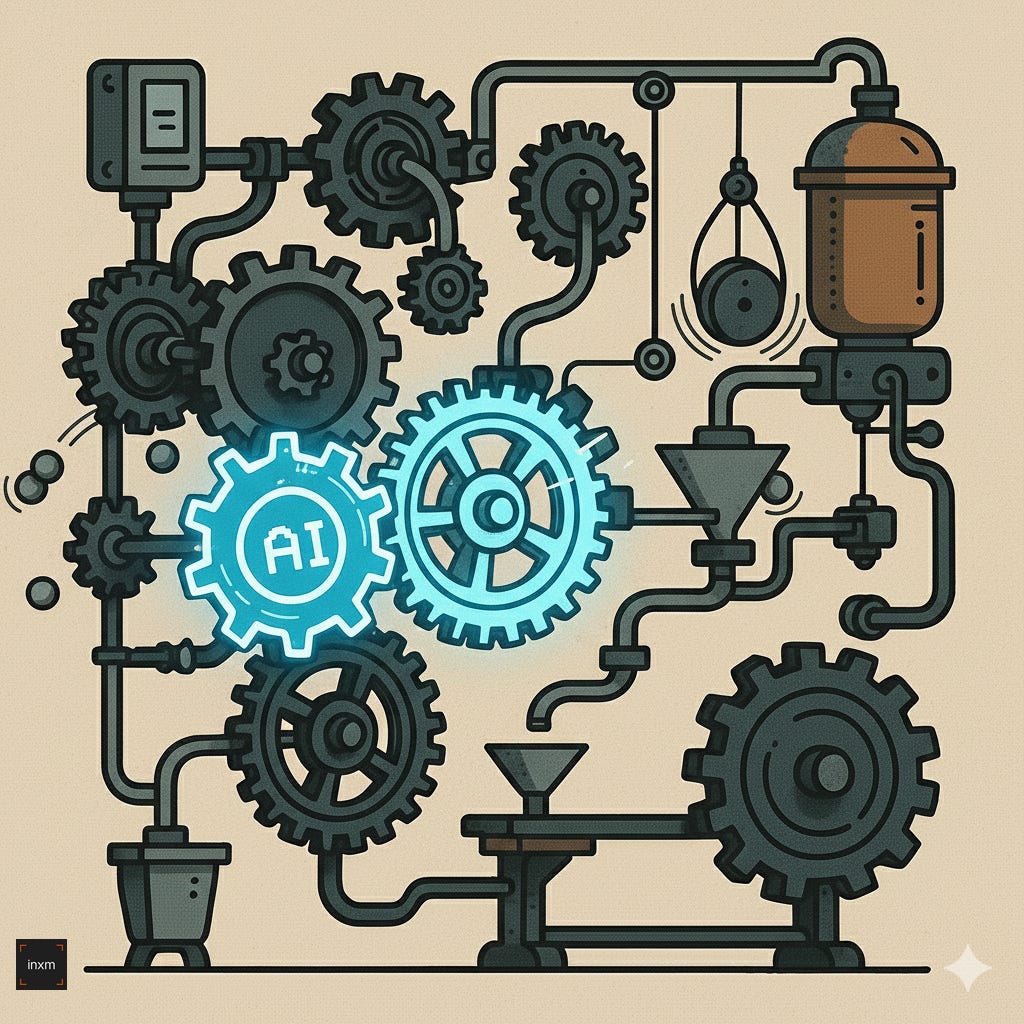
Technology has developed into a terrible place. I've written about it before, and I'm sure I'll write about it again. But if you thought the single-page application and its fancy, slow friends were a problem, you haven't seen anything yet.
The newest shiny toy in the world of technology, and the one that promises to solve all our problems, is of course AI. From chatbots that can write your company's emails to agents that can automate your entire business, the promises are as grand as they are vague. You see the demos, the proud declarations of a new era of productivity, the CEOs gushing about how their teams will finally be free from the drudgery of, well, doing their jobs.
And then you try it.
You type the same prompt into the same chatbot, and you get two different answers. Or maybe the first answer is great, but the second one is... not. It's a bit like a magic trick where the magician forgets the second part and just stands there awkwardly. It’s exactly the opposite of what you want when you’re running an enterprise. As the great Kent Beck once said, agents are “genies” because they give you what you wish for but in their own way, and not what you expected. They're a little bit mischievous, a little bit unpredictable, and a whole lot of a liability.
The enterprise promise of AI is being hindered by this lack of dependable, repeatable results. You can't build a business on a foundation of "maybe." You can't tell your shareholders that the new AI system will save you 20% on operational costs, but only on Tuesdays and if it feels like it. It's the ultimate doom for any serious business that relies on predictable outcomes. You see the demos from our friends in the marketing departments, showing off how the same prompt for a sales report can give you a bulleted list one day and a haiku the next. Not what you want when you need to close the quarter.
And what's worse? The idea of agents running unattended in the background, like digital gremlins. They'll be automating things, sure. But what are they automating? Destroying your databases? Sending embarrassing emails to your clients? Or maybe just quietly siphoning off your business logic into a dark corner of the internet. The risks are astronomical, and yet, we're all told to just trust the black box.
To understand the core issue, we have to look at the math. A large language model's output isn't a single answer; it's a probability distribution over every possible word or "token." When you ask it to do something, it's making a series of probabilistic choices. Think of each step in an agent's workflow as a coin flip where the probability of a correct outcome is always less than 1.
Before even getting to the math, it helps to understand why these systems wobble in the first place. LLMs don’t “reason” in any grounded sense—they stitch together statistical associations. Self-attention aligns tokens by probability weights, embeddings map words or snippets into vector spaces based on corpus similarity, and training optimizes for the most likely next token, not for truth. On top of that, inference adds instability: randomness from sampling, precision loss from quantization, memory limits in long contexts, and the absence of any built-in validation. The result is a system that looks confident but is always just a few probabilistic slips away from going off-script.
And this brings us back to the numbers. Even if each step in a workflow has a seemingly high chance of being right - say P(correct)=0.99 - those small cracks add up. When an agent needs to perform a sequence of tasks, those probabilities multiply. The total probability of success for a workflow with n steps is P(total)=0.99 ^n. As the number of steps grows, the total probability of success drops exponentially. For a workflow with 10 steps, your chance of a completely correct outcome is 0.99^10≈90%. For 100 steps, it's a mere 0.99^100≈37%. This is why reliability becomes a nightmare. And the majority of LLMs today are still far from achieving a stable 99%. Do you really want to have an agentic system based on that knowledge running unattended in the background, executing your high risk business processes?
Some may say that a good agentic system can correct its own errors, making the steps not truly independent. Others (rightly so) will tell you this is an oversimplification, and I cannot simply apply multiplicative laws of probabilities to an agentic system like a math punk. While that's true, it just means the math gets more complicated; the fundamental problem of decaying reliability for long tasks remains. And while, indeed, work is done to make models “less stochastic” in their output, ie via Feedback Loops, grounding, planning, task decomposition, the problem is both foundational and multilayered, and it’s not solved now, nor will it ever be fully solved.
So, what's the light at the end of the tunnel? What we need is a platform that combines the native language understanding from AI, with the reliability of enterprise. The ease of creating new agents, without handing over the control to agents that run unattended in the background, destroying your databases and your business.
We believe that the most most realistic solution involves moving away from the idea of a single, all-purpose LLM agent. Instead, a successful agentic system will be a hybrid of a stochastic LLM for creative, high-level reasoning and planning, and deterministic, rule-based, or traditional code for critical, verifiable, repeatable or arithmetic tasks.
We give you the power to collaborate on creating processes that are then baked into reproducible, immutable workflows. Workflows designed with ISO rigor: precise logs, strict audit trails, unambiguous accountability. Less genie in a bottle, more master chef in a kitchen where every step follows the recipe, down to the gram.
This is the realisation that we started building from. We knew where we wanted to go, but not exactly how to achieve it.
Our platform is the orchestration layer that bridges the gap between AI hype and your real-world ROI. Think of it as your operating system for AI. We give you one central place to deploy, manage, and monitor your AI agents. Turning unpredictable genies into a reliable team members that multiply the power of your human employees.
The outcome? With INXM you can be more productive while saving a ton on operational costs. We give you the power to tame the AI beast, don’t let it run rampant in your business.
Want to see it? Patience, my dear reader. Do subscribe and we will keep you posted!