

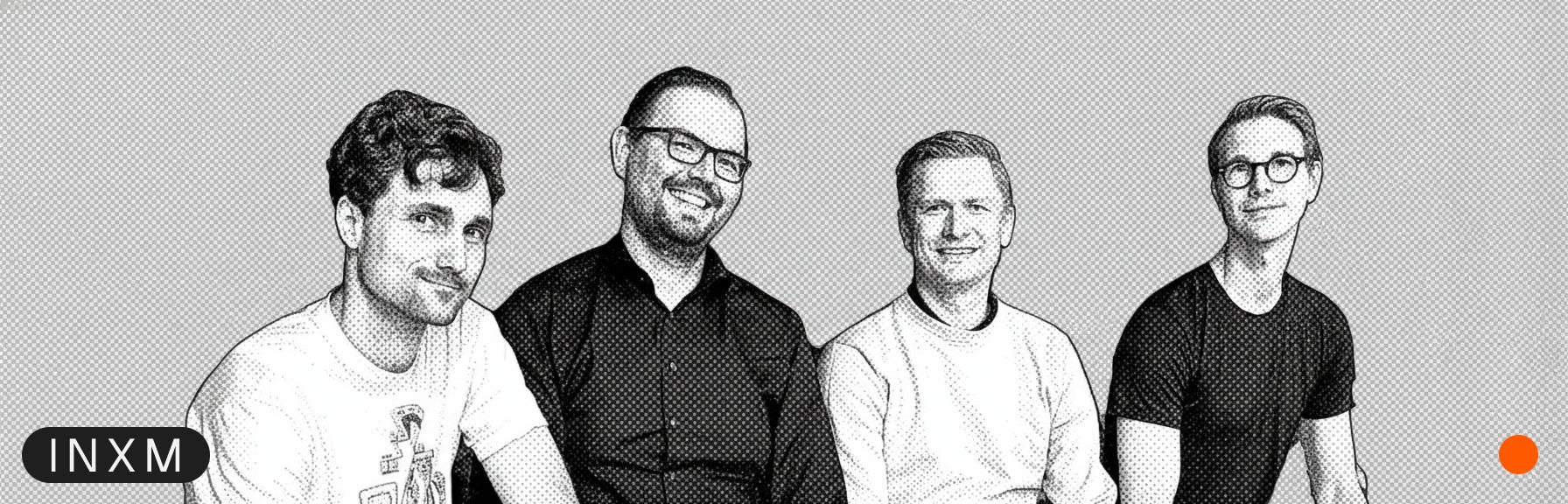
Today, I’m proud to officially announce our founding team on this journey: Matthias Kainer, Jesper Bylund, and Kamil Klüber and me, Alexander Oelling. Together, we’re building INXM—a future‑of‑work platform shaped by people who’ve shipped rockets, air taxis, industrial automation, and AI‑native products.
Four Perspectives on Building Digital-Physical Systems That Actually Work
Most digital transformation projects fail because they optimize for technology instead of outcomes. Here’s what happens when you combine deep technical expertise, human-centered design, industrial operations, and enterprise scaling—all in one room.
Matthias has spent 25+ years turning organizational chaos into working systems. From early Microsoft code to orchestrating mission-control dashboards at Isar Aerospace and Volocopter, he’s specialized in the hard stuff: replacing legacy COBOL fleet applications with cloud-native microservices, building launch orchestration systems, and doing it in a way that transforms team dynamics rather than just technology stacks. The results speak for themselves: greater than 90% team engagement scores, not through perks but through systems that match how people actually work. He’s published on organizational change, AI, and DevOps, and spoken at DevOpsCon and XP Days. His core insight: technical architecture and organizational design are the same problem viewed from different angles.
Jesper leads AI design at n8n and has spent his career making powerful systems feel intuitive. His portfolio spans flight control software, clinical data platforms, social platforms, video games, and B2B SaaS—domains where complexity is inherent and comprehensibility is critical. His current focus: designing for human-AI collaboration where the AI’s reasoning is legible rather than opaque. In regulated industries and high-stakes workflows, this isn’t about making AI look simple—it’s about making it comprehensible. Users need to understand not just what the system recommends, but why, so they can build trust and maintain control.
Kamil started in metal construction and welding, learning production from the ground up. He’s run projects across the complete value chain—from first customer contact through series production—and helped design automotive production machines that now generate millions in revenue. His experience spans SMEs and global players like HELLA, BASF, and Siemens, where he specialized in end-to-end digitalization and SaaS sales. At INXM, he brings operational depth and commercial focus to revenue, partnerships, and industrial-grade solutions. His advantage: he knows what works on factory floors, not just in presentations.
Alex has 20+ years delivering digital strategies, cloud environments, enterprise applications, cyber security, and IoT across regulated industries. As former Chief Digital Officer at Isar Aerospace and Volocopter, and founder/board member at Sensorberg, he’s built the organizational infrastructure that makes digital transformation actually scale. He helped create VoloIQ for urban air mobility and built internal IT teams, budgets, and processes under aerospace standards—where you need simultaneous speed and rigor, agile development and formal verification, rapid iteration and certification-grade traceability.
What we’re building (and how we’ll do it)
We’re focused on the hard, boring, valuable work: connecting people, process, and data into workflows that actually run the business. Our principles:
AI‑native from day one — copilots that explain, not obscure.
Graph over glue — a shared data model instead of brittle point‑to‑point scripts.
Consumer‑grade UX — built for shift leads, controllers, and analysts, not just developers.
Compliance‑by‑construction — traceability, role‑based access, and audit trails as first‑class citizens.
Why now
Work has outgrown yesterday’s ticket queues and spreadsheet choreography. AI is powerful, but without an operational memory and clear governance, it’s noise. We’ve lived this gap in aerospace, mobility, AI tooling, and manufacturing. INXM is our answer: a platform that turns fragmented tools and tribal knowledge into reliable, explainable AI driven workflows.