

More than once I’ve had friends send me long docs triumphantly, clearly believing they’ve solved some problem, or won some argument. But when I skim it, it’s mostly empty platitudes and some telltale signs of an LLM. You’re absolutely right!
It can seem like AI is flooding us with slop. But this isn’t a new problem, just an old problem at a higher velocity.
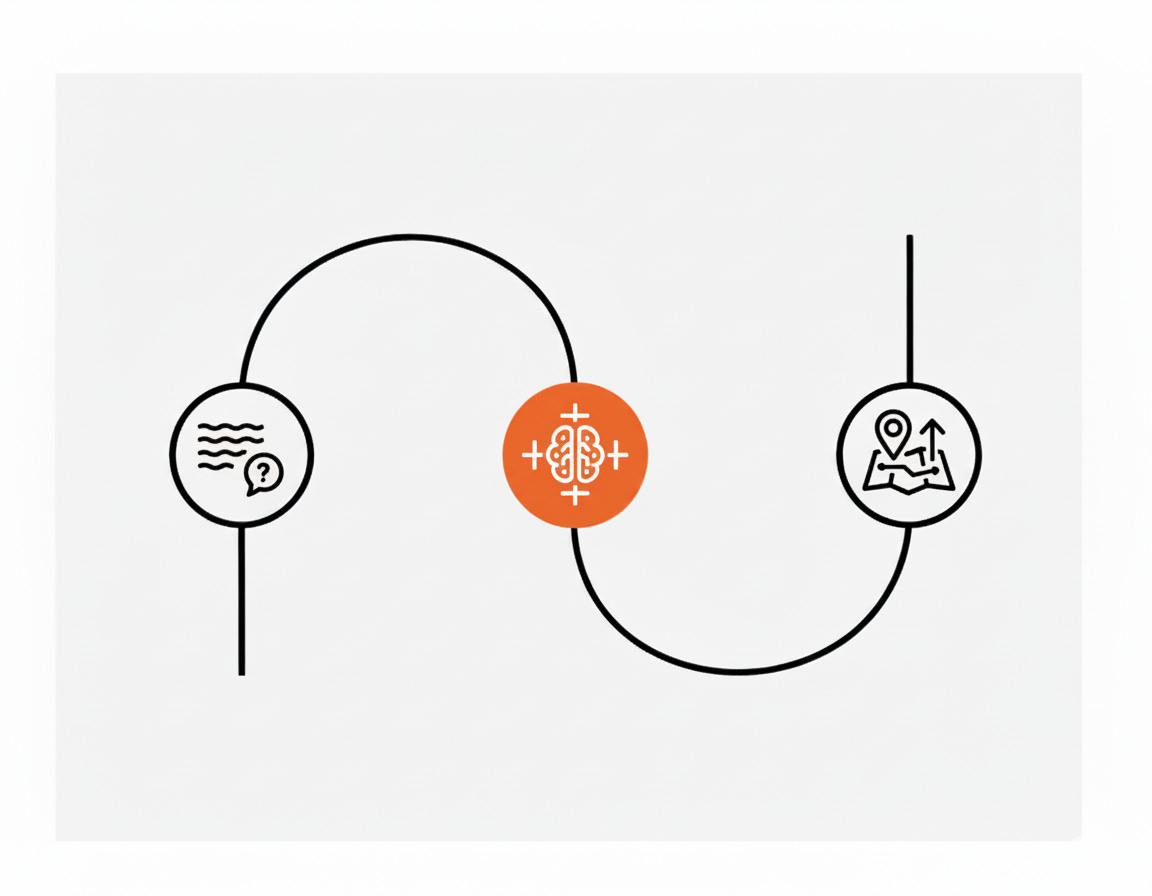
Text as a medium
Text is a magical medium. It lets us send information forwards in time. It can communicate complicated ideas. And it’s very information dense. The right words can communicate an entire world in a paragraph.
Compared to spoke language, reading and writing has a much higher rate of signal to noise.
But text is also demanding. Writing takes a lot of effort. There is even some evidence that rendering fuzzy thoughts into the right words is the active form of thinking. This makes text less great for moments when you need a lot of actions.
Thinking: super fast but fuzzy
Speaking: fast but vague
Writing: slow but specific
This tells us something about how to design better tools for work.
Thought experiment: designing better tools
Imagine if your car was self driving but you would have to manually text it where to go: “Right, Left, Left, Right”. That keyboard would be pounded to bits.
What about voice? Less information dense and takes less effort. Better in the car too. But you’d still get very tired of saying “Right, Left” quite soon.
The better way is to shape the context of information around what the user is trying to do. In a car they always have a destination, so a natural language UI can simply parse that, and then use a routing service to understand where to go. Close to zero effort for the user, they can verify on a map that the car got it right or wrong, no need to read a long text.
“Context is the interface The best agents don’t stay in isolated chat dialogues. They move into surfaces we already trust. “I feel like a browser … because you can do an infinite number of things on a browser and we’re all using browsers.”
— Liam Matteson, Browserbase
This is how we thinking about the future of work.
What is the context our user is in? She’s between meetings, in her email, chatting in teams, or in a face to face conversation. She’s trying to reference data, or complete some process, in her companies software suite.
Anything from “create a new deal flow pipeline in our CRM”, and “look up the material costs of regional projects”, to “Did procurement respond about this request from last week I don’t remember?”
Each request can be made simply through natural language, or through a specific User Interface depending on the users context.
Coming back to our car analogy: INXM Orchestrator understands enough about the landscape she’s in to realise which systems are needed to perform this journey.
Orchestrator then presents that specific UI, in this case a map, to the user so she know where she’s going. And can even add extra stops along the way if they need.
When she accepts, Orchestrator fires off this journey plan as a series of tasks in the systems and programs she normally uses. The map shows her the current progress. And if anything changes Orchestrator will ping her to let her know.
The future of Ai, and of software, is not about reading and writing more text. It was always going to be about showing you information more intelligently. Making it easier for the human user to take the right actions at the right time.
For INXM this means we spend an absurd amount of time testing what information is right for which actions. What is the “map” for something as complicated as “material costs of regional projects”?
This future of work wont be perfected any time soon, but we’re excited about the steps we have already taken. And we cant wait to see you put more work on cruise control.