

The excitement around teams of AI agents collaborating on a tasks is understandable, but the ROI is limited. Running three coding agents or building self-reinforcing loops of sub-agents is not the endgame. If we want to have a real scaling effect on businesses, the future of work will look more like orchestrating hundreds of thousands to millions of operations across a company. Even more in enterprise.
As an example: in procurement the unit of work is not “one agent completing one task for Bob”. It is thousands of small, repeatable decisions and actions executed with audit trails. Agents, and Agent Swarms, can’t keep up with that. So what does?
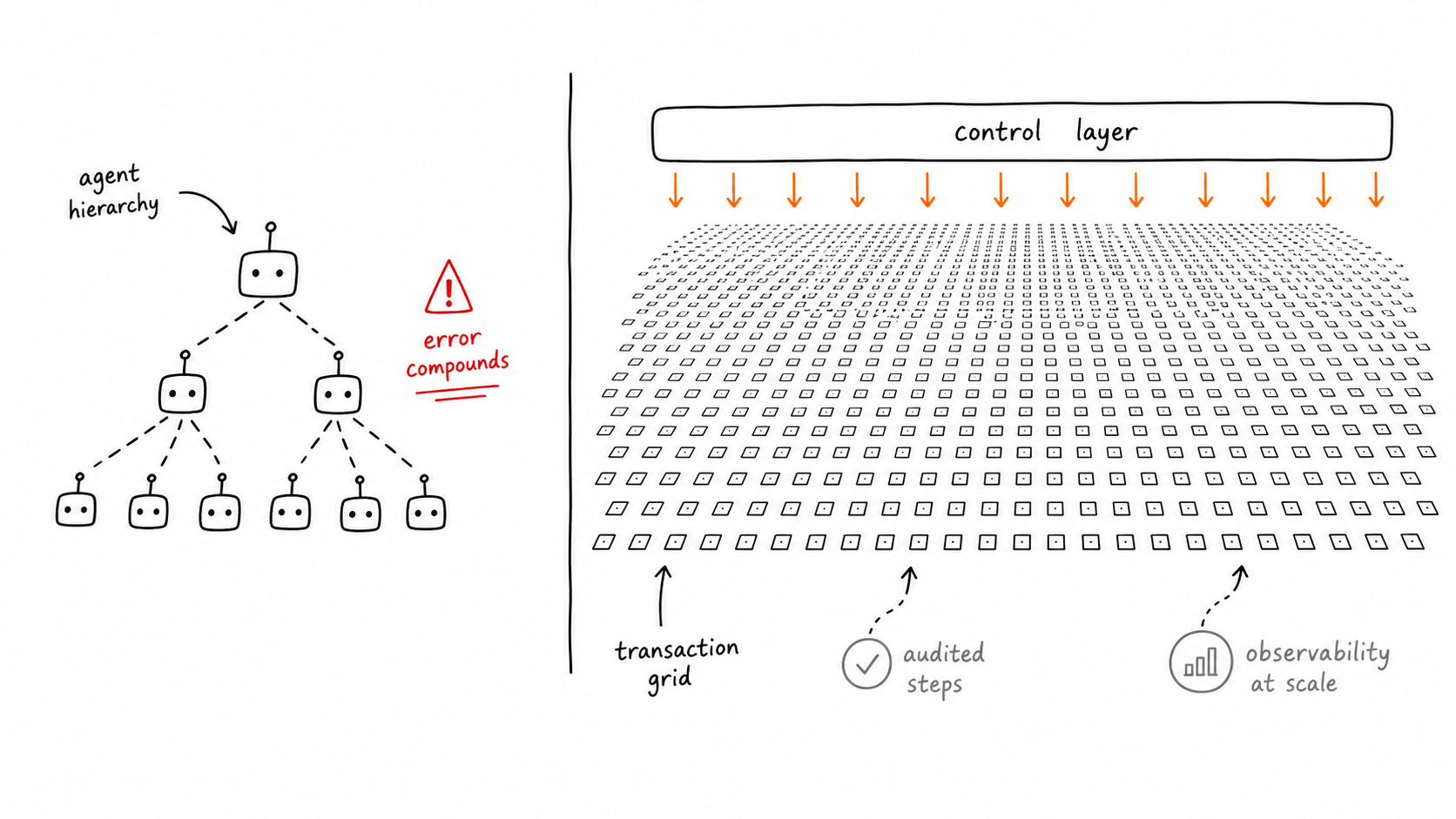
Why Current Agent Metaphors Fail
Most implementations of Agents today rely on hierarchies (manager agents overseeing worker agents) or swarms pursuing one goal at a time. These metaphors break when we scale up. Error rates compound: each supervisory layer adds mistakes and false positives. Or worse, they create a massive token overhead for supervision and correction. Creating a negative ROI. You’d be better off hiring more interns.
The fundamental problem is treating agents as the core primitive is the wrong way to scale.
We do not need to “organize twenty agents”. Maybe a bakery can make a lot of profit with that. But we need to run 300,000+ reliable transactions. Stochastic parrots won’t scale for that.
The Right Primitive: Deterministic Transactions
The fundamental primitive must be audited, deterministic transactions. Reliable, compiled steps with clear inputs/outputs. We call this Compiled AI.
Agents need to switch roles as the scale increases. They translate user intent, route exceptions, and serve as human-interface glue.
What we want isn’t a roman legion of LLMs (a popular metaphor for organizing agents into groups), what we want is something like a steering wheel. A basic human interaction, that translates into a lot of reliable machine actions.
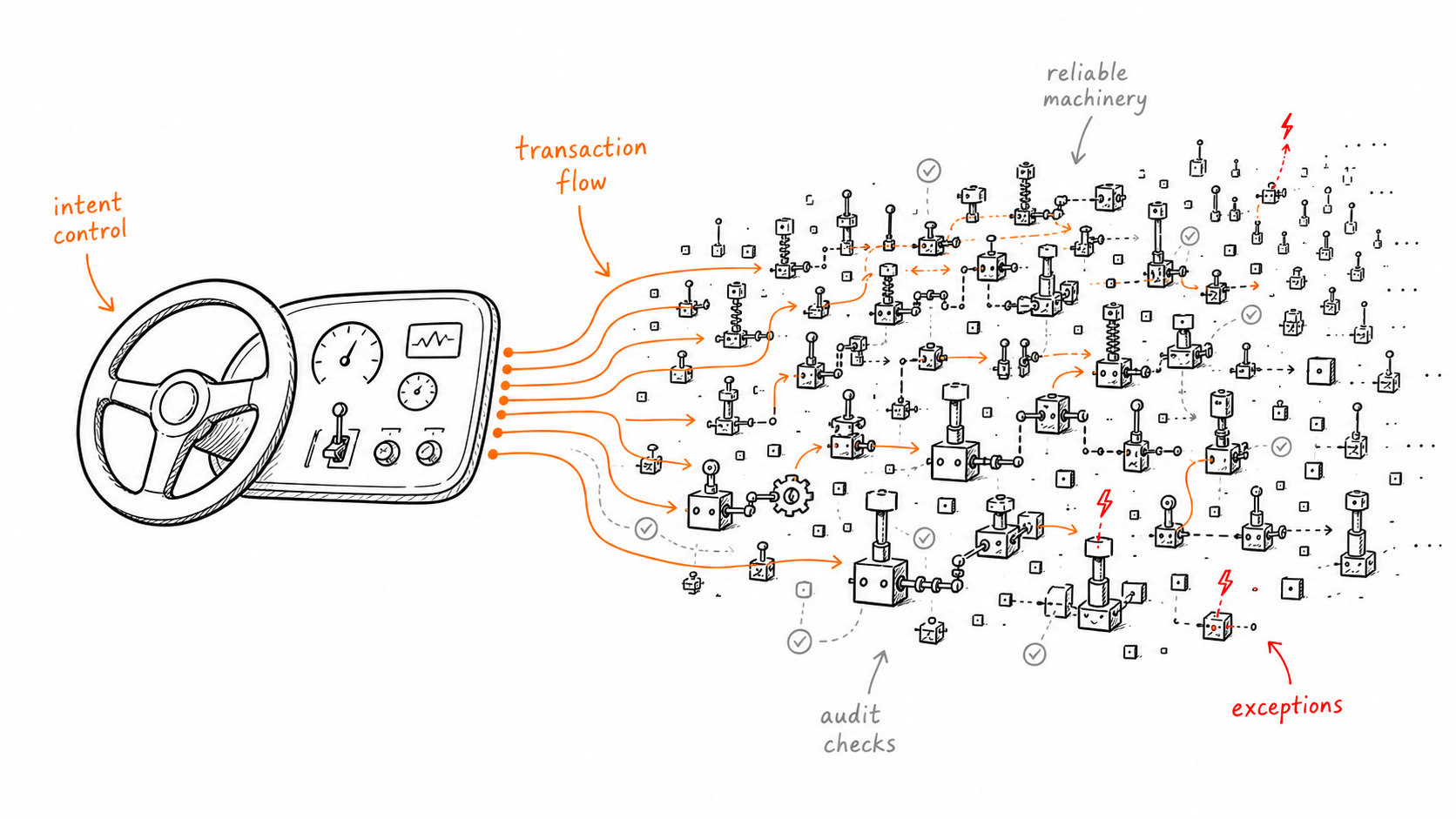
The Computer Science Solution: Orchestration as the Operating System
Computer science solved this decades ago through orchestration. The best metaphor for this is an operating system.
In a traditional Operating System like windows or iOS the following happens:
Users interact with apps.
Apps request actions from the OS.
The OS schedules, validates, and executes millions of low-level operations reliably.
We are building the same thing for enterprise work: an Enterprise Operating System, we call it a Process Execution Engine.
Top layer: Human users give high-level intent.
Middle layer: The orchestrator schedules, validates, secures,and executes millions of low-level operations reliably.
Bottom layer: Deterministic, auditable transactions (Compiled AI).
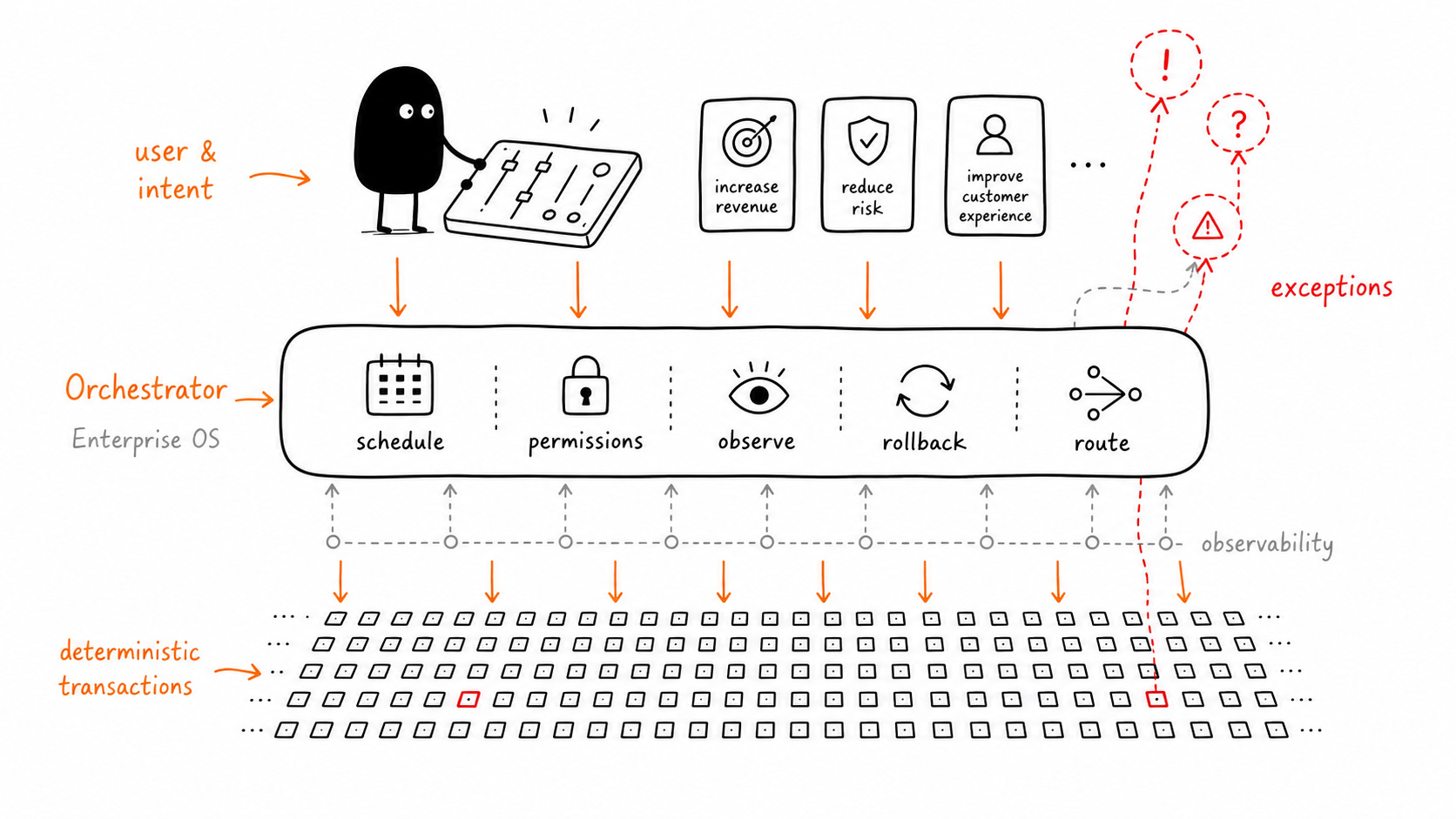
Unlike agent hierarchies, this contains errors in typed, inspectable, reversible transactions instead of letting stochastic agents supervise each other, and praying it will work next time.
How It Works
User expresses high-level intent.
Orchestrator maps it to sequences of deterministic transactions (which we call Plans).
System executes at massive scale with built-in controls.
Only true exceptions and decisions surface to the human.
If you’re “AI-pilled” you might start asking why there isn’t another AI above this? But there is no need for an “orchestrator of orchestrators”, at the highest level the problem becomes human alignment on priorities and tradeoffs.
That’s your company strategy, and needs to remain in the hands of humans.
Why Orchestration is a better metaphor
Thinking about AI this way scales cleanly to enterprise volumes. Want to to 100 tasks? Fine. How about 30 000 000? Yeah, no problem.
This maintains the enterprise governance we’ve spent decades creating in IT. It shares the same observability, and audibility you’d expect from any modern software.
It keep humans focused on the strategy and judgment, where it matters. And not on maintaining the stability of AI agents.
The future of work
We think orchestration can transform work. Every action a human wants to do becomes a reusable transaction. Tasks and processes are discovered and mapped as a side effect to people doing their normal work. And no one is left behind in “searching for documents hell” again.
The future is not autonomous agent armies. It is an Enterprise Operating System, a Process Execution Engine, that turns reliable transactions into a orchestrator of work at scale. We already know how to build this in computer science. Now we are applying it to organizations.
That is how we think AI will reshape enterprise work.